Mitochondria: What You Need to Know

Mitochondria are dynamic organelles at the center of cell vitality and function. Their role goes far beyond the classic "powerhouse of the cell." They do govern energy production, but also apoptosis, redox balance, and cell signaling, making them a pertinent target for drug development, cosmetic claim substantiation, and predictive health models.

What Is a Mitochondrion?

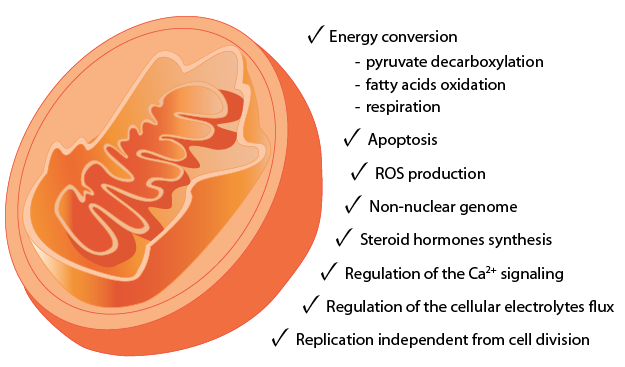
The mitochondrion is a highly interactive organelle that sits at the center of cell vitality. Present in nearly every cell of the body, mitochondria carry out essential functions including energy conversion, apoptosis, ROS production, steroid hormone synthesis, calcium signaling, and regulation of cellular electrolyte flux. Unlike most cellular components, mitochondria carry their own genome and replicate independently from cell division.

Schematic of a mitochondrion listing its functions.

Despite decades of research, mitochondria remain a rich field of discovery. Their roles in disease, aging, cellular stress, and therapeutic response are highly complex, and new insights continue to emerge, which is why mtBiolabs continues to develop new models and co-develop patient-derived disease models with its partners.

Targeting Mitochondria

Disease Applications

Mitochondria are essential to cell metabolism and survival, and their molecular constituents are key targets of drug development in metabolic disease, cancer, CNS diseases, and cardiovascular risk management. Altered mitochondrial function and behavior have been recognized across these conditions.

In cancer cells, for example, the Warburg effect (a shift from oxidative phosphorylation to glycolysis even in the presence of oxygen) is commonly observed. Different cancer cell lines show different Warburg statuses and central metabolism markers, and respond differently to anti-cancer drugs.


A Novel Drug Target

Targeting mitochondria can help reverse the effects a disease has on them, or trigger apoptosis in diseased cells. While mitochondrial targeting presents challenges such as delivery, it also opens up real opportunities in drug development.

Mitochondrial bioenergetics can be targeted with uncouplers, and explored in anti-cancer as well as anti-obesity research. Apoptosis can be targeted through the permeability transition pore, validated in cancer and cardioprotection. Redox status is a relevant target in hypoxic conditions, CNS defects, and infectious disease.

Targets for Toxicity

Drugs can injure mitochondria regardless of their intended target: off-target effects may impact the mitochondrial electron transfer chain, mitochondrial DNA content, and the redox balance of the cell.

Mitochondrial dysfunction is recognized as one of the most important causes of drug-induced liver and cardiac injury, making mitochondria a highly pertinent target for toxicity screening.

Why and When Should You Care?

From Insight to Strategy

Mitochondria play a central role in cells and are affected in many diseases. Understanding a disease's impact on mitochondria brings you one step closer to understanding the disease itself. Studying mitochondria can also help you move more swiftly through drug development and approval by detecting efficacy and toxicity early, saving time and money by ensuring you pursue the best, safest drug candidates.

Toward Personalized Medicine

Drugs can have different effects across a population. mtBiolabs develops decision-making technologies to help partners create safer, more targeted drugs, such as determining which cell-line profiles respond best to a given drug, or which react adversely to it, in order to target the appropriate patients.

By combining systems biology and molecular exploration, mtBiolabs separates homogeneous phenotype groups within a population, leading to the discovery of pertinent biomarkers. These metabolic profiles can support companion diagnostic strategies that help ensure a drug reaches and benefits those most likely to respond.

Frequently Asked Questions

What is a mitochondrion and what role does it play in the cell?

A mitochondrion is a dynamic organelle found in nearly every cell of the body. It plays a central role in energy conversion (ATP production), apoptosis, reactive oxygen species (ROS) production, steroid hormone synthesis, and calcium signaling. Mitochondria carry their own DNA and replicate independently of cell division, making them a unique and pertinent target for both research and therapeutic development.

Why are mitochondria considered a target for drug development?

Mitochondria sit at the intersection of energy metabolism, cell survival, and cell death, processes that are disrupted in metabolic disease, cancer, CNS conditions, and cardiovascular disease. Modulating mitochondrial bioenergetics, apoptosis pathways, or redox status offers therapeutic opportunities across these areas, while also serving as an early readout of a drug's mechanism of action.

What is the Warburg effect and why does it matter for cancer research?

The Warburg effect describes a shift in cancer cells from oxidative phosphorylation to glycolysis, even when oxygen is available. Different cancer cell lines display different Warburg statuses and central metabolism markers, which influences how they respond to anti-cancer drugs, making mitochondrial profiling a valuable tool in oncology drug development.

How does mitochondrial dysfunction relate to drug-induced toxicity?

Off-target effects of drugs can impair the mitochondrial electron transfer chain, mitochondrial DNA content, and cellular redox balance. These impairments are recognized as a leading cause of drug-induced liver and cardiac injury. Screening for mitochondrial toxicity early in pre-clinical development helps reduce the risk of late-stage failures or post-market adverse events.

Why are mitochondria relevant to cosmetics and skin health?

Mitochondrial activity drives cellular energy production, oxidative stress response, skin vitality, and longevity. Cosmetic actives that support mitochondrial function can help substantiate claims around energizing, anti-aging, antioxidant, and protective benefits — backed by direct measurement of mitochondrial behavior in living skin cell models.

Can mitochondrial data guide personalized therapies or cosmetic strategies?

Yes. By analyzing mitochondrial activity, mtBiolabs can identify which cell populations respond best to a given intervention. This supports personalized drug strategies, targeted cosmetic formulations, and biomarker-driven decisions and helps ensure a product or drug reaches and benefits those most likely to respond to it.

Contact

Curious how mitochondrial testing applies to your drug, cosmetic, or wellness program?

Contact us to discuss your study